Start innovating with the Building Blocks
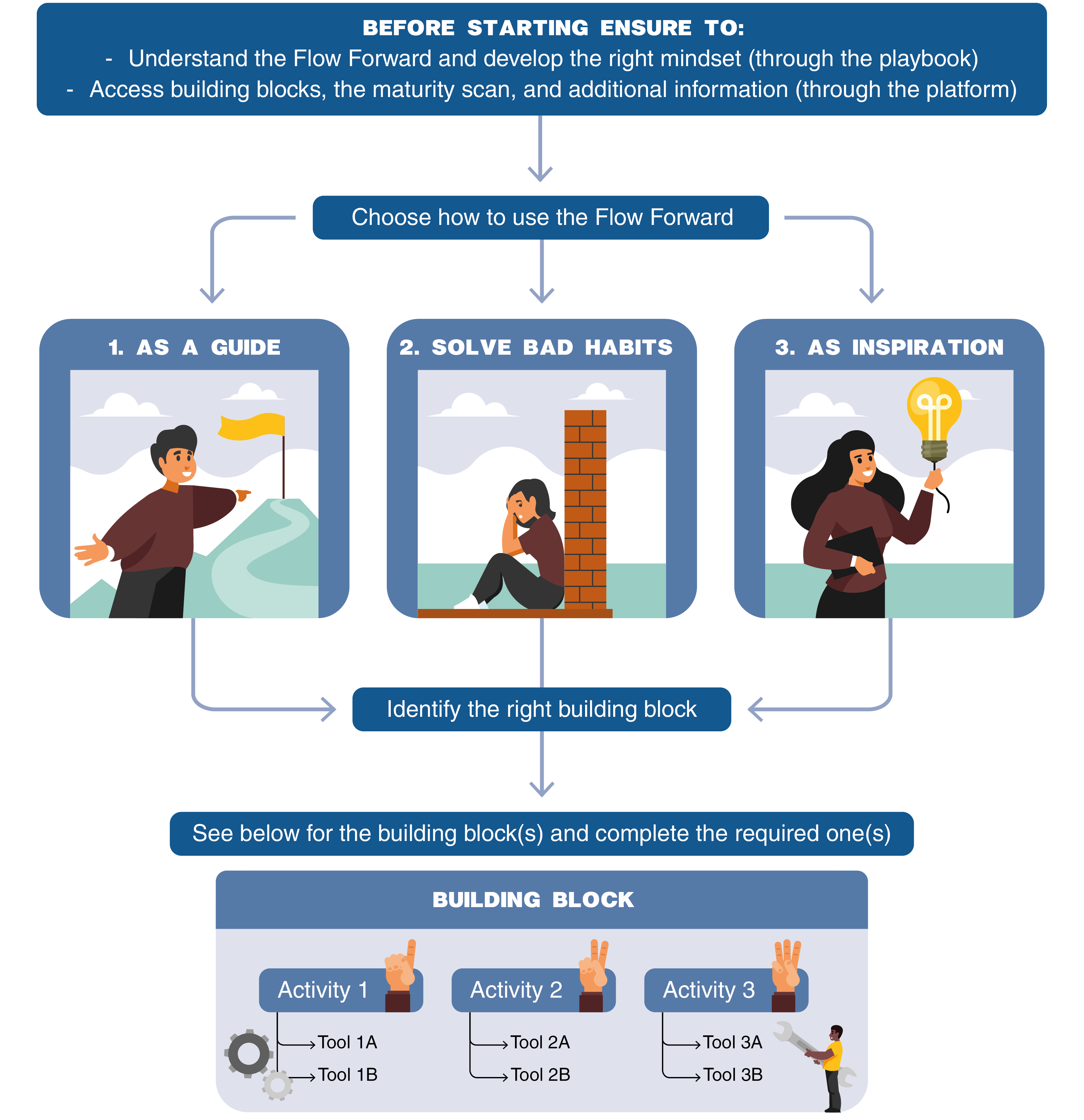
Building Blocks are the main components of the Flow Forward methodology. They are practical, step-by-step action plans designed to tackle specific innovation challenges, such as setting an agenda or launching a first experiment.
Start with the playbook
The Flow Forward Playbook is your guide to understanding and applying the Flow Forward methodology. It explains the mindset, framework, and core principles behind the approach and helps you understand how to navigate.
You do not need to read the playbook from start to finish. Simply explore the sections that are most relevant to your challenge and use it as a guide throughout your innovation journey.
Need help? Contact us!

To understand the Flow Forward:
Download the playbook
To discover your bad habits:
Download the bad habit cards
Building Blocks overview
Building Blocks are the core of the Flow Forward methodology. To ensure they are practical and easy to use, every building block is organized into two layers that provide step-by-step guidance on specific tasks:
- Activities (what to do): each building block consists of two to three activities. These are the essential, structured actions required to perform the building block.
- Tools (how to do it): Every activity is supported by one or two practical tools. These are practical helpers such as templates, canvases, checklists, or workshop formats, that facilitate the work and structure your results.
The Flow Forward offers a rich library of building blocks, which can be found below. They are organized into a logical 3x3 matrix based on two dimensions: the three key innovation aspects (Ecosystem, Experimentation, and Governance) and the three maturity stages (stage 1, 2, 3).
-
{{theme.title}}
{{buildingBlocksCtrl.buildingBlockData.title}}
About this building block
Goal of this building block
{{ buildingBlocksCtrl.buildingBlockData.goal }}
Result of this building block
{{ buildingBlocksCtrl.buildingBlockData.result }}
Steps to complete this building block
{{activity.title}}
{{ activity.description }}
Flow Forward Scaling Approach
You have conducted an experiment and want to explore how to take your solution further. The Flow Forward Scaling Approach helps you determine step by step what is needed to scale: from an initial check of your current situation to a concrete short- and long-term scaling route.
There are two ways to use the approach. If you are taking your first steps towards scaling, steps 0 and 1 are a good place to start. If you have already been working on scaling your solution for some time and want to look further ahead, we also recommend going through steps 2 and 3 to develop a longer-term perspective.
0. checklist “Ready to scale?
Before you start scaling, it is useful to first check whether your solution is ready. Use the Scaling Readiness Checklist to assess your current situation. The checklist helps you identify where you stand and which areas may still need attention before you can scale.
You don’t have to tick every box to move forward. Scaling is part of innovation, and complete certainty is never possible. Trus and courage matter too: new insights will emerge along the way. What matters is having a sufficiently solid, evidence-based foundation to take the next step.
If many questions remain unanswered, use the checklist to identify what you need to work on first.
→ Download here: Scaling Readiness Checklist
1. Scaling ambitions workshop
In the Scaling Workshop, you explore what is needed to scale your solution further. You start by looking at three key questions:
- Desirability: who really needs the solution?
- Feasibility: can the solution be built and maintained in the long term?
- Viability: how can the solution sustain itself financially?
You then explore six themes that are important for your scaling strategy: core assets, potential showstoppers, new markets, reach, diversification and the required team.
An important part of the workshop is determining what scaling means for your solution. Different types of scaling offer different opportunities, such as expanding to new areas, adding functionalities or applying the solution in other domains. Exploring these options helps you identify the approach that best fits your ambitions.
At the end of the workshop, you translate your insights into a concrete scaling strategy, defining your key priorities, milestones and next steps.
Three tools support you throughout this step:
→ Download here: Scaling Canvas and explanation of the workshop: Explains how to set up the workshop and guides you through completing the canvas step by step.
→ Downlaod here: Cue Cards: Help you ask and answer the right questions for each of the six themes.
→ Download here: Types of Scaling: Provides an overview of different scaling approaches, with explanations and examples to inspire you and help identify the best strategy for your ambitions.
2. Future vision
Now that the short-term direction is clear, it is time to look further ahead. Where should the solution be in three to five years?
Start by creating a Future Press Release: imagine it is three to five years from now and write a press release announcing the solution’s success. Describe how the solution is used in practice, what value it creates, who benefits from it and how it has become part of its wider context. This helps make the future tangible, turning an abstract ambition into a concrete and shared picture of what success looks like.
Next, use this future vision as the starting point for the Future Value Map. Explore how the solution works in this future scenario and map out the ecosystem that makes it possible: which parties and partners are involved, which technologies are needed, and how information, services, products and money flow between them. Together, develop a concrete and shared understanding of the future solution and the relationships, resources and collaborations needed to make it a reality.
→ Download here: Future Value Map (1st part of the document)
3. Future backcasting and milestones
From the future vision, work backwards towards the present. What developments, milestones and actions are needed to reach the desired future?
With Future Backcasting, you work backwards step by step from the future vision. You identify what needs to happen just before success, which hurdles need to be overcome, and which innovations and actions are needed to get things moving.
You then translate this into a Plan of Action. Compare the current situation with the future vision and identify the most important gaps. Then determine which milestones are needed to move from the current situation towards the desired future.
This results in a concrete long-term route, which can then be further translated into actions for the short term.
→ Download here: Future Backcasting (2nd part of the document)